When Should Young Players Start Tennis Strength Training?
Oct 08, 2026A Practical Guide for Parents and Coaches
Strength training is not just for adult athletes.
When introduced appropriately, strength training can be an important part of a young tennis player's long-term development.
But that doesn't mean putting a young player under heavy loads or asking them to train like an adult.
The better question isn't simply:
“How old should my child be before they start strength training?”
It's:
“What type of training is appropriate for their age, development, experience and ability?”
For young tennis players, the goal should be to build a strong physical foundation that supports their tennis — while allowing them to develop progressively as athletes.
What Does Strength Training Mean for a Young Tennis Player?
When many parents hear “strength training,” they immediately think of barbells, heavy weights and bodybuilding.
That's not what junior strength training needs to look like.
For a young player, strength training can include learning how to:
- Squat
- Lunge
- Push
- Pull
- Brace
- Rotate
- Land
- Jump
- Balance
- Control their body through different movements
Bodyweight exercises, resistance bands, medicine balls and appropriately selected external resistance can all have a place in a progressive training program.
The emphasis should be on movement quality, control and gradual progression.
These fundamental movements provide the foundation for more advanced strength, speed and power training as the player develops.
So, When Should Young Players Start?
There isn't one universal age at which every young tennis player should begin the same type of strength training.
Children develop at different rates.
Their training experience, physical development, movement ability and ability to follow instructions all matter.
For younger players, training may focus primarily on:
Movement → Coordination → Balance → Body control
As players become more experienced, training can progressively introduce:
Strength → Speed → Power → Sport-specific physical qualities
The important part is that the training develops with the player.
Start With the Foundation
Before worrying about how much weight a young player can lift, ask:
Can they control their own body?
Can they:
- Land with control?
- Squat with good technique?
- Lunge and maintain balance?
- Move in different directions?
- Control their trunk?
- Stabilise on one leg?
- Coordinate their arms and legs?
- Follow basic movement instructions?
These abilities provide a foundation for more advanced training later.
A young athlete doesn't need to rush through this stage.
Good movement is something worth developing before simply adding more load.
Strength Training Isn't Just About Getting Stronger
For tennis players, strength is useful because tennis requires players to repeatedly produce and control force.
A player needs to:
- Push off the ground
- Accelerate toward the ball
- Stop and decelerate
- Change direction
- Stabilise during strokes
- Produce force through the legs and hips
- Transfer force through the trunk
- Maintain control throughout the movement
So junior strength training shouldn't exist separately from athletic development.
The bigger goal is to help the player become a better mover and develop as an athlete.
What About Speed and Power?
Strength is only one part of the picture.
As a young player develops, their physical training can also include speed and power.
Think about the relationship:
Strength → Force
Power → Force produced quickly
Speed → Moving quickly
Tennis requires all of these qualities.
But they don't necessarily need to be developed through the same exercises or at the same stage.
A young player may first need to learn how to control a landing before being asked to perform more advanced jumping exercises.
They may need to develop basic strength before progressing to more demanding power exercises.
That's why progression matters.
How Should Junior Strength Training Progress?
A simple way to think about progression is:
Stage 1 — Learn the 5 Primal Movements
Before a young tennis player starts adding weights to their strength training, they should first be able to perform the 5 fundamental movement patterns:
1. Lunge
2. Squat
3. Pull
4. Push
5. Rotate
With good technique, control and stability using just their body weight.
As demonstrated in the video above, mastering these movements builds a strong foundation, reduces the risk of injury and prepares the body for more advanced strength training.
Master the movement first, then add the load!
Stage 2 — Build Strength
Introduce progressively more challenging exercises and resistance while maintaining good technique.
As players become ready for more structured training, the Junior Strength Development Program provides a progressive approach to developing strength and core fitness.
Stage 3 — Develop Speed and Power
Once the player has an appropriate foundation, training can become more explosive.
This may include:
- Jumps
- Bounds
- Medicine ball exercises
- Explosive movement drills
- Speed and agility work
Stage 4 — Apply It to Tennis
The physical qualities developed in training can then support the demands of tennis:
Accelerate → Brake → Change direction → Hit → Recover → Repeat
The exact progression will depend on the individual player.
Does Strength Training Make Young Tennis Players Slow?
This is a common concern.
But strength training itself isn't what determines whether a player becomes faster or slower.
How the training is designed matters.
Young players shouldn't simply perform large amounts of slow, heavy training and expect that alone to develop their tennis movement.
A well-rounded athletic program can include:
Strength + Speed + Power + Agility + Movement
The goal is not to choose one quality and ignore the others.
It's to develop the physical qualities that support the player's overall athletic development.
What Should Parents Look For?
If you're a parent looking for strength training for your young tennis player, don't focus only on:
“How much weight can they lift?”
Look for a program that considers:
Age and development
Training should be appropriate for the player's current stage.
Technique
Exercises should be taught and performed with appropriate control.
Progression
The player should gradually progress rather than constantly jumping to more difficult exercises.
Variety
Tennis requires more than one physical quality.
Tennis demands
Training should ultimately support the movements and physical demands of the sport.
Long-term development
The goal isn't simply to make a young player tired.
It's to help them develop over time.
Don't Develop Just the Tennis Player
A young tennis player isn't only a tennis player.
They're an athlete who is still developing.
That's why their training should help them develop:
Movement.
Strength.
Coordination.
Speed.
Power.
Balance.
Body control.
The goal isn't to replace tennis practice.
It's to develop the athlete alongside the tennis player.
As players progress, a more complete Junior Strength & Conditioning Program can help develop a broader range of physical qualities.
The Bigger Picture
Junior development shouldn't be about trying to make a young player perform like an adult as quickly as possible.
It's about building the qualities they can continue to develop as they grow.
That means:
Learn to move.
Build the foundation.
Develop strength.
Develop speed and power.
Apply those qualities to tennis.
Progress over time.
The best training plan isn't necessarily the one that makes a young player work the hardest.
It's the one that helps them develop appropriately, consistently and progressively.
Final Takeaway
So, when should young tennis players start strength training?
The answer isn't simply a number.
Young players can begin developing strength-related qualities through age-appropriate movement, coordination, body control and progressive resistance training, with the exact approach changing as they develop.
The goal is not to rush them into advanced training.
The goal is to give them the physical foundation they need to become stronger, faster, more powerful and more capable tennis players over time.
Build the athlete.
Then build the performance.
Want to help your young tennis player build a stronger athletic foundation?
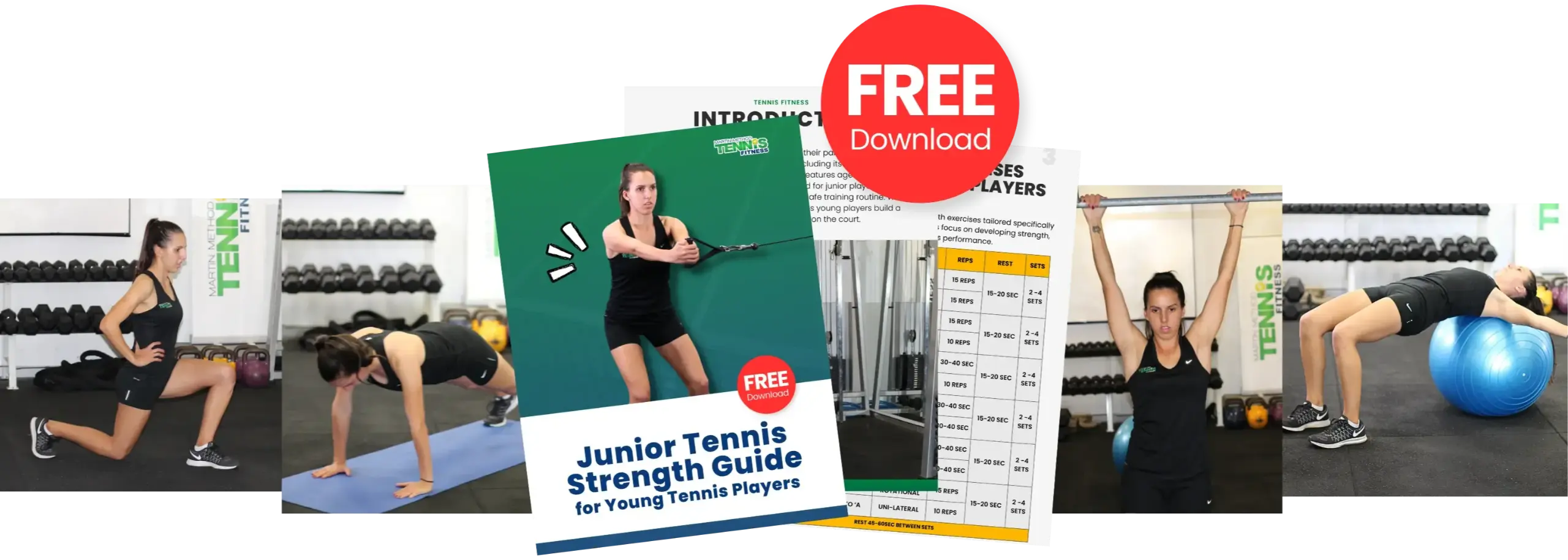
Our Free Junior Strength Program is designed to give young players a structured place to start developing their physical abilities alongside their tennis.
Get the Free Junior Strength Program →